



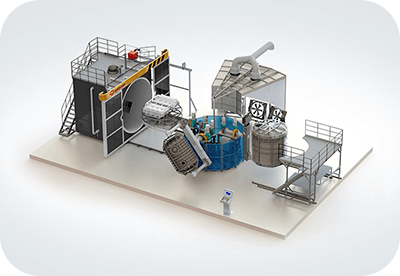
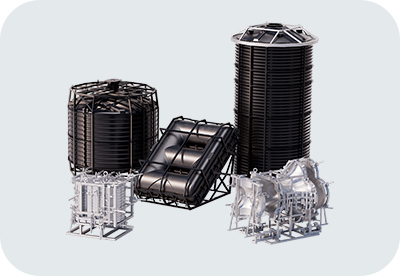


From large outdoor water tanks and septic tanks to small playground equipment and agricultural parts, many hollow plastic products owe their existence to an unsung yet highly effective technology — rotational molding (commonly called rotomolding).
Not as widely known as injection molding or blow molding, rotomolding has established a solid foothold in the hollow plastics arena thanks to its unique strengths: no pressure required, minimal material waste, and the ability to produce large, complex products. Today, we’ll break down rotomolding in plain language — from how it works to why it matters — so anyone can understand it, even without an engineering background.
I. The Basic Principle of Rotomolding: 4 Steps to Make a Hollow Plastic Part
The core idea is easy to remember: plastic powder slowly melts inside a spinning mold, coats the inner walls, and hardens upon cooling. Unlike injection molding or blow molding that rely on high pressure, rotomolding runs entirely pressure-free — gentle yet efficient. Here are the 4 steps:
1. Loading: Pouring Plastic Powder into the Mold
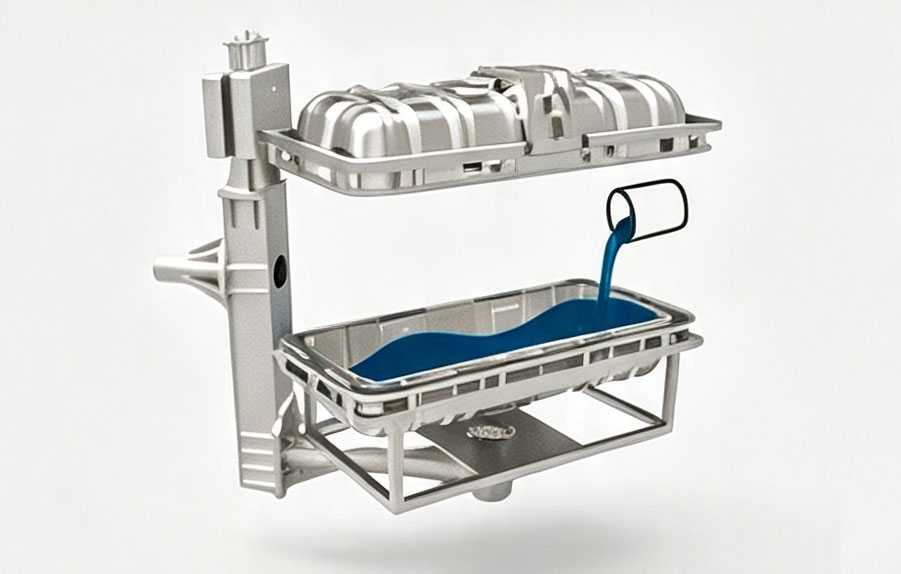
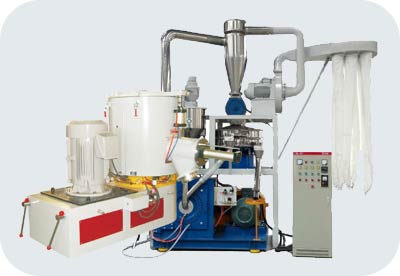
A precisely measured amount of plastic powder (typically polyethylene or polypropylene — the same material used for everyday plastic basins and buckets) is loaded into a preheated mold. Key requirements: the powder must be dry and uniformly sized; color masterbatch and additives like UV stabilizers must be thoroughly mixed. Otherwise, the finished product may have bubbles or uneven coloring.
2. Heating & Rotating: The Core Step — Making Powder Coat Every Surface
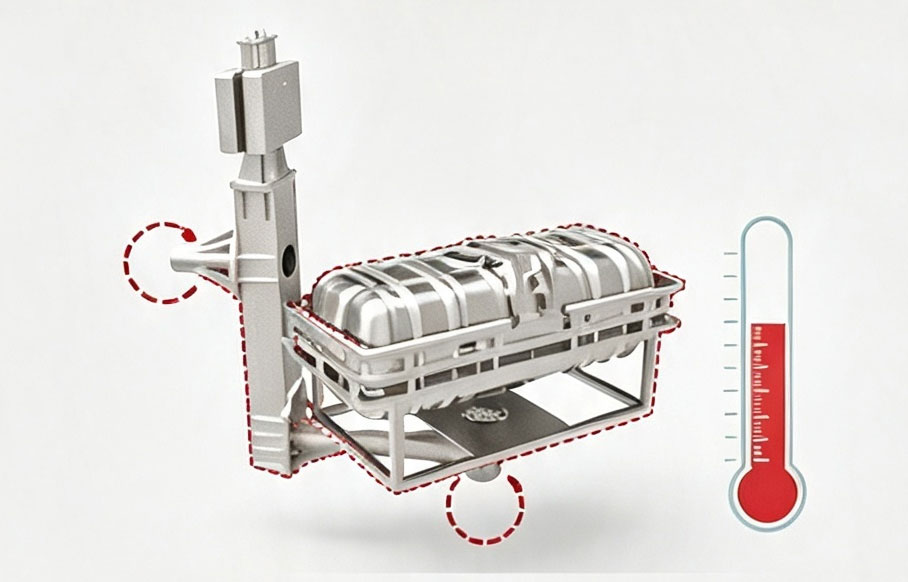
The mold loaded with powder enters a heating chamber and performs a “biaxial rotation” — think of it like the Earth spinning on its axis while orbiting the sun. The heating temperature is controlled at 200–400°C (adjusted based on the plastic type), and the rotation speed is slow (2–15 RPM). Under the combined effect of heat and rotation, the plastic powder gradually melts into a viscous flow state and, driven by centrifugal force, evenly coats the entire inner surface of the mold — filling even the smallest corners.
3. Cooling & Solidifying: Setting the Shape
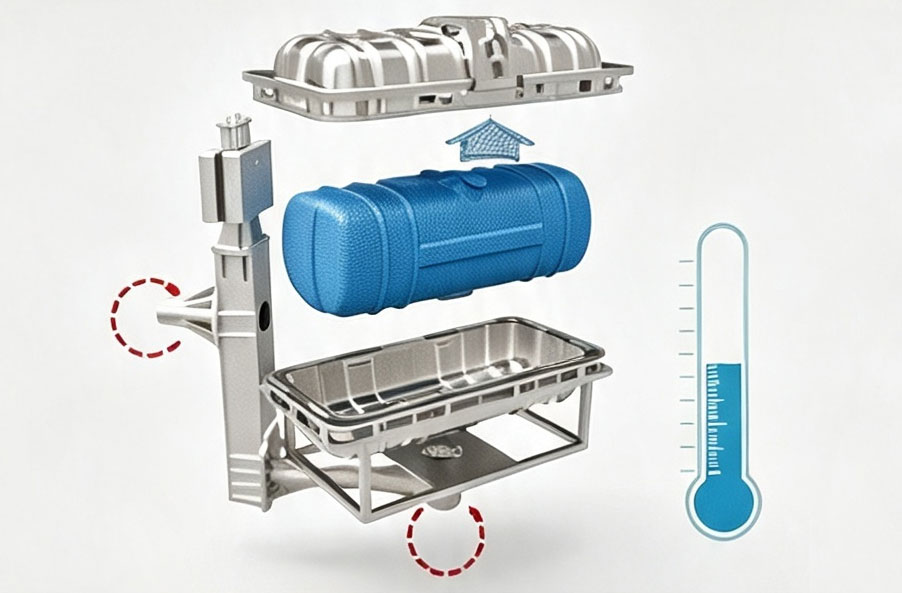
After heating, the mold moves to a cooling chamber where it is cooled by forced air, water mist spraying (most common), or water immersion, allowing the molten plastic on the inner wall to harden and set. The cooling rate must be carefully controlled; otherwise, the product may warp or crack.
4. Demolding: Removing the Finished Product
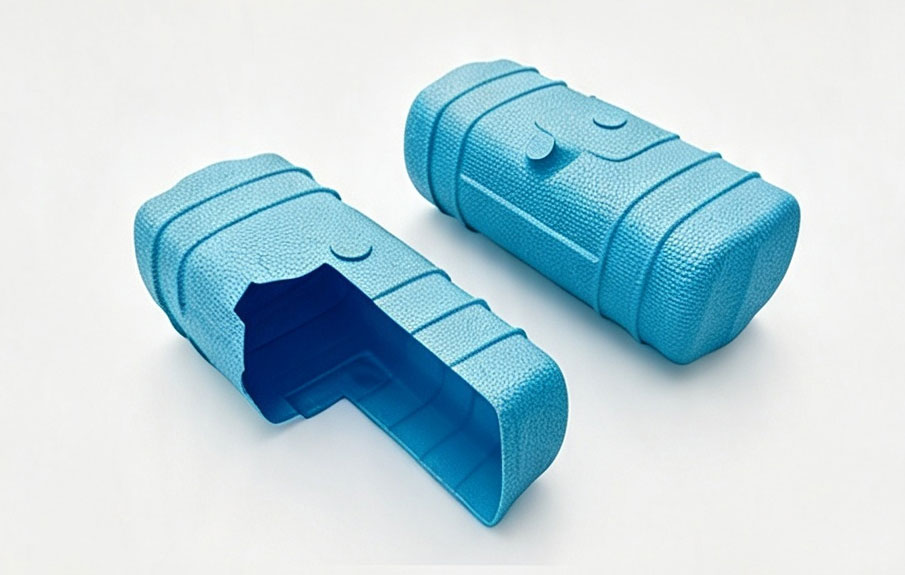
Once the mold stops rotating and fully cools down, a complete hollow plastic product is ready. Good mold design ensures the product can be easily removed without scratches or deformation.
II. The 6 Core Advantages of Rotomolding: No High Pressure, Almost Zero Waste — This Is Its Killer Edge
Rotomolding stands out from other plastic molding methods thanks to these 6 irreplaceable advantages:
1. Unlimited Design Freedom — Make Any Shape You Want
No high pressure needed, so molds don’t have to withstand extreme forces. This enables complex shapes — parts with internal threads, reinforcing ribs, double-wall hollow insulation components, and even oversized water tanks or septic tanks can be molded in one piece, with no weld seams and greater structural integrity.
2. Durable & Long-Lasting Products
Rotomolded products have no weld seams or fusion lines, and the internal stress is evenly distributed, giving them excellent impact and fatigue resistance. For example, outdoor water tanks can withstand years of sun, wind, and minor impacts without cracking or deforming — far outlasting assembled alternatives.
3. Almost Zero Waste — Major Cost Savings
This is one of rotomolding’s biggest selling points! Unused plastic powder can be 100% recycled and reused. By contrast, injection molding generates 20%–30% waste (such as sprues and runners). This saves material costs and is better for the environment.
4. Low-Cost Molds — Low Barrier to Entry
Rotomolding molds don’t require high-grade steel — ordinary thin-wall steel plates or aluminum alloys will do. They are simple to manufacture and don’t need complex runner systems or cooling channels. Compared to injection molds of the same size, rotomolding molds cost 30%–70% less, making them ideal for small-batch production and product prototyping.
5. Cost-Effective Even for Small Batches — High Flexibility
Because molds are affordable and quick to change (typically 5–20 minutes per mold swap), rotomolding is economical even for small-batch, multi-product runs. For instance, developing a custom plastic component in a special specification doesn’t require a huge upfront investment — perfect for new product development.
6. Excellent Product Performance — Wide Range of Applications
The polyethylene materials commonly used in rotomolding are acid/alkali resistant and UV stabilized, so outdoor products won’t degrade easily over years of exposure. They can also meet food-grade safety standards, making them suitable for chemical, agricultural, and consumer applications alike.
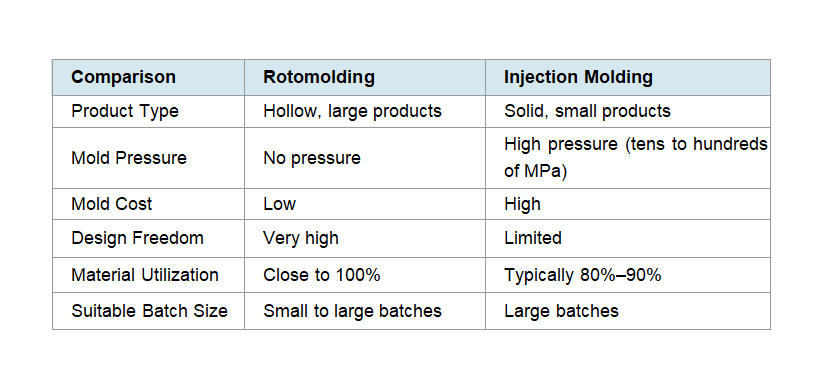
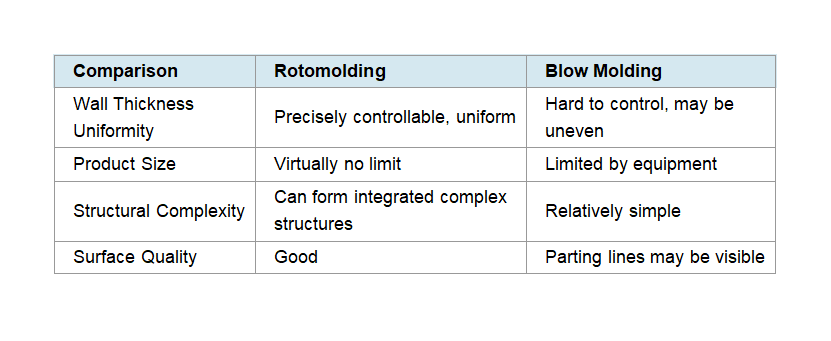
III. How Does Rotomolding Compare to Injection Molding & Blow Molding?
Rotomolding vs. Injection Molding
Rotomolding vs. Blow Molding
IV. When Should You Choose Rotomolding? A Quick Guide
Rotomolding isn’t a cure-all, but in its areas of expertise, it’s virtually unmatched. Keep these scenarios in mind for a quick assessment:
1. Ideal Scenarios for Rotomolding
• Large hollow products: Tanks over 500L, water tanks, septic tanks
• Complex structural parts: Components with internal threads, mounting bosses, or reinforcing ribs
• Small-batch custom products: Prototype development, special-specification parts
• High corrosion resistance requirements: Chemical storage/transport, water treatment equipment
• Cost-sensitive projects: Limited mold budget
2. Scenarios Where Rotomolding Is Not Recommended
• High-volume standardized products: Injection molding is more cost-effective
• High-precision small parts: Dimensional accuracy requirements within ±0.1 mm
• Transparent products: Rotomolded parts typically have haze
V. How the Principle Connects to the Advantages
The reason rotomolding holds an irreplaceable position in certain fields lies in the core advantages that stem directly from its unique working principle:
• Pressure-free molding → Low mold cost, high design freedom
• Biaxial rotation → Uniform wall thickness, rational stress distribution
• Powder raw material → High material utilization, recyclable
• Heating & cooling control → Stable, consistent product performance
This logical chain — “principle determines advantage, advantage determines application” — forms the complete value system of rotomolding technology.
Conclusion: The Heart of Rotomolding — The Wisdom of “Working with the Flow”
As a seasoned rotomolding engineer once said: “Rotomolding isn’t a cure-all, but in the areas it excels at, nothing else comes close.” Next time you see a large outdoor plastic water tank or a playground structure, consider this: it might just be a masterpiece of rotomolding.
A great manufacturing process needs dedicated practitioners to carry it forward. Rising Sun Rotomolding has been deeply committed to this industry for over two decades — not seeking the spotlight, just focusing on refining rotomolding technology from R&D to production, with careful attention at every step. If you’re interested in rotomolding or have custom requirements, we invite you to learn more. Let the professionals handle the professional work.
Contact information:
www.risingsunroto.com
info@risingsunroto.com




 浙公网安备 33108102000897号